European Malls Accelerate Food Court Automation as Robot Kiosks Replace Traditional Shops: 2026 Retail Automation Report

Sep 18, 2026
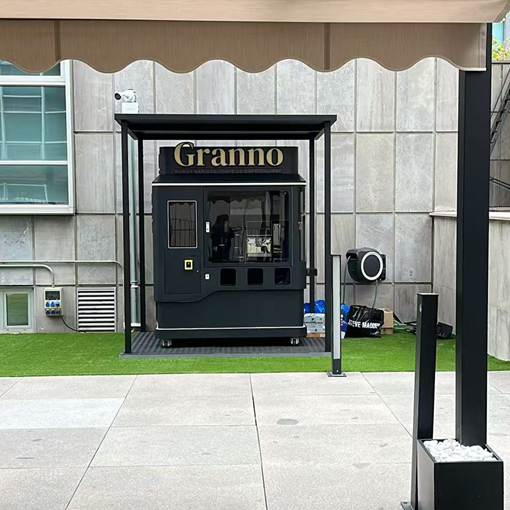


Shenzhen, Guangdong Sep 17, 2026 (Issuewire.com) - European shopping center operators are restructuring food court strategies at an unprecedented pace, replacing traditional staffed counters with autonomous robot kiosks to address labor shortages, rising operational costs, and shifting consumer expectations for 24/7 service availability. A new analysis of 2025-2026 deployment data across 12 European markets reveals that automated beverage and food kiosks now represent the fastest-growing tenant category in mall renovations, with payback periods averaging 6-12 months and gross margins exceeding 85% per cup.

According to Grand View Research, the European retail vending machine market is projected to reach USD 2.47 billion by 2033, growing at a 4.5% CAGR from 2025. Beverage vending machines -- led by coffee automation -- account for 39% of revenue share and represent the fastest-growing segment. Simultaneously, major European landlords including NEPI Rockcastle, Eurofund Group, and Finiper Group have committed over EUR 50 million in food court modernization projects since 2024, with digital ordering infrastructure and autonomous kiosk integration as core design requirements.

"The food court of 2026 looks fundamentally different from 2020," said a spokesperson for Moocoo, a Shenzhen-based manufacturer of AI-powered beverage robots deployed in 60+ countries. "Mall operators are no longer asking whether to automate -- they're asking how many kiosks they can fit per square meter of reclaimed space."

The shift is driven by three converging pressures. First, hospitality labor costs across the EU have risen 30% since 2021, with Spain, Germany, and France reporting the steepest increases in minimum wage and social contributions. Second, traditional food court operators face 130%+ annual staff turnover, creating chronic coverage gaps during peak hours. Third, consumers have normalized contactless, app-based ordering -- a behavior accelerated by the pandemic and now expected as standard.

Deployments across Europe illustrate the trajectory. In Germany and Austria, Moocoo units operate in shopping centers across Heilbronn, Hamburg, Berlin, and Vienna, as well as Cologne/Bonn Airport. Each unit prepares up to 120 cups per hour with a 650-serving refill interval. In Bulgaria, Moocoo launched the country's first robotic latte artist inside a Kaufland supermarket in Sofia, marking the entry of AI-driven beverage automation into mass-market grocery retail. In the Netherlands and Sweden, Moocoo 6th Generation units have achieved 24/7 outdoor operation in The Hague and Stockholm, with design lifespans exceeding 10 years and 500,000 cups per unit.

Financial modeling from operational deployments shows consistent economics. At an average ingredient cost of $0.30-$0.70 per cup and retail prices of $3.50-$5.00, gross margins reach 84-93%. Break-even occurs at 40-60 cups daily before location fees; with typical mall commissions of 15-20%, profitable operation stabilizes at 80-120 cups daily. High-traffic placements near escalator landings, cinema lobbies, and food court entrances consistently achieve 200-400 cups daily, yielding payback in 6-12 months.

"Location strategy is the single variable that determines success," noted a retail automation analyst tracking European deployments. "A robot kiosk in a quiet corridor fails. The same unit at a transition point -- between parking and retail, or cinema and dining -- captures impulse purchases at 1-2% conversion of foot traffic."

Mall operators are structuring deals to share upside. Revenue-share leases with minimal fixed rent have become standard, aligning landlord and operator incentives. Typical terms: 6-12 month trial periods, 15-20% revenue commission, with renewal options at reduced rates once sales velocity is proven. This model reduces landlord risk while enabling operators to test multiple locations before committing to long-term agreements.

Regulatory pathways have also matured. CE certification, FDA compliance, and UKCA marking are now standard across leading robot kiosk manufacturers, streamlining health department approvals. Enclosed, antimicrobial stainless-steel interiors with automated high-temperature cleaning cycles (85°C+) satisfy the stringent hygiene audits required in German, French, and Nordic markets.

Moocoo's AI coffee robots, certified for CE, FCC, and ISO 9001, are currently deployed in shopping centers, transit hubs, and universities across Europe. The company's 6-axis robotic arm achieves ±0.03mm precision and 98% brewing consistency, with cloud-based fleet management enabling remote monitoring of inventory, maintenance, and sales performance across multi-site portfolios. For operators evaluating European market entry, Moocoo provides site assessment, revenue modeling, and deployment support from its EU logistics hub.

The broader implication extends beyond coffee. Ice cream robots, cocktail kiosks, and bubble tea automation are following the same deployment playbook, creating a new category of "light retail" -- high-margin, zero-labor, relocatable units that transform underutilized mall space into continuous revenue streams. As European landlords prioritize revenue per square meter over traditional lease income, the food court is evolving from a cost center into a diversified automation portfolio.

About Moocoo

Moocoo is a Shenzhen-based national high-tech enterprise specializing in AI-driven unmanned retail solutions. With 70+ national patents, CE/FCC/ISO 9001 certifications, and deployments in 60+ countries, the company designs and manufactures robotic coffee, ice cream, bartender, and bubble tea kiosks for high-traffic venues worldwide. Moocoo's mission is to eliminate the operational complexity of traditional food service through precision robotics, cloud intelligence, and turnkey deployment.

Media Contact

Shenzhen Moocoo Technology Co., Ltd


[email protected]

https://www.moocoo.com/

Source :Shenzhen Moocoo Technology Co., Ltd

This article was originally published by IssueWire. Read the original article here.

MORE NEWS
Why Democrats are pivoting to thirst traps

Oct 26, 2026

Why Democrats are pivoting to thirst traps

“It is a very real dynamic that you could have all these videos about Jon Ossoff, and it's not seen as detracting away from his overall message or his seriousness as a politician,” The 19th’s Grace Panetta said on Vox’s Today, Explained podcast. | Elijah Nouvelage/Getty Images Democrats have been emphasizing lots of issues in the runup to the 2026 midterms: The Iran war. The state of the economy and healthcare. Corruption. And…hotness. Specifically, their candidates: The internet is awash in clips of Michigan candidate Abdul El-Sayed pumping iron and podcasters proclaiming that “America deserves a hot president” in a video interspersed with photos of Georgia Sen. Jon Ossoff. Having a good-looking candidate is by no means a new tactic — famously, it may have helped John F. Kennedy win election over Richard Nixon — but the online left is adapting that strategy for the internet and fandom age.  Grace Panetta, a politics reporter for The 19th, wrote about how “thirst edits” of Ossoff in particular are proliferating online. Panetta says the organic origins of a lot of these videos are of particular interest to Democratic operatives, who see it as a way to gain back ground they lost on the internet after the 2024 election.  Panetta spoke with Today, Explained co-host Sean Rameswaram about who’s thirsting over Democratic politicians in the first place, how 2026’s hot candidates are different from those of yore, and whether it’s actually giving them a boost.  Below is an excerpt of their conversation, edited for length and clarity. There’s much more in the full podcast, so listen to Today, Explained wherever you get your podcasts, including Apple Podcasts, Pandora, and Spotify. Where are these edits coming from? Regular online creators. And it’s important to note at the outset that these are not paid partnerships. The campaign is not paying these influencers to make edits about how they think their candidate’s really attractive.  That’s partly why I wanted to dig into it, because it’s organic. These are just online creators wanting to draw visibility and attention to a candidate that they really like. Jon Ossoff is currently running for reelection in these midterms. How do we know for sure that he isn’t somehow behind the campaign? I spoke to several creators who make these videos and they said that they’re doing it for the love of the game and they’re just supporters. His campaign did not give me a quote or a statement for this story. So it’s fair to assume that he’s not directly involved and he doesn’t repost these videos.  But as people pointed out to me, his campaign knows that they have an attractive, compelling candidate. And they’ve previously been vaunted for their digital strategy this cycle of putting out very high-quality livestreams of his rallies. There’s a lot of material for an enterprising TikToker who wants to make these edits or clips. They have a lot to work with.  His campaign, as one person put it, is definitely playing into that, but not directly engaging. It’s a fine line to walk. Is it just an Ossoff thing or is this going on with other candidates? I do recall that Abdul El-Sayed hits the gym. Famously so. Yes, he hits the gym. I just watched so many videos for this story. I also came across a fair number of Gavin Newsom edits. There are people who think he gives sort of a Patrick Bateman, American Psycho vibe. There are also official Democratic accounts, including the TikTok account for the DNC, the headquarters account, which was formerly Kamala HQ, who have been posting edits of Ossoff and also Abdul El-Sayed, who kind of leans into this gym-bro persona.  The headquarters account posted a side-by-side of Ossoff and Abdul El-Sayed with the caption, “There are 69 days until election day.” Nice. Yes. There are also lots of edits of Mamdani, and former President Barack Obama. Obama nostalgia content goes hard on the internet. So you’re seeing these more official side Democratic campaign accounts leaning into it and playing up their candidates. Having an attractive candidate is nothing new. You mentioned Obama. JFK was famously dashing. What feels different about what you’re seeing now on social media? I think this is really a culmination of a lot of different things happening right now in politics and specifically within the Democratic Party.  After their loss in 2024, there was a lot of conversation about the gerontocracy, how we’re governed by a lot of really old people, for the most part, in this century. And also about Democrats’ digital strategy and the aftermath of 2024.  One thing that a lot of people in that digital space have been talking about is how Republicans and the Trump campaign really capitalized on getting that organic engagement on platforms like TikTok and Instagram, where a lot of Americans are now going to get at least some of their news, and also engaging with and encouraging the creation of this kind of organic content on platforms and from creators that are not always expressly political or official-side.  “A candidate’s messaging strategy is only as good as the content and only if it meets people where they are and actually speaks to a real need people have.” As one Democrat I talked to put it, she thinks it’s a way for Democrats to win back the internet and to really create a contrast with the Republicans. And she said to have fun on the internet because Republicans are having fun on the internet and it appears to be working for them, or at least it was in 2024. Is there something about this being something on the left that makes it sort of tricky? This is, broadly speaking, objectification, right? It is a fine line between thirst and objectification. And there is also a gendered element to it that it is mostly men that these types of videos are being made about.  Now, granted, a lot of people make sort of hype edits or positive content about AOC because she’s a very popular female politician on the left, but it’s true that women candidates are held to higher standards in terms of how they present themselves and how their supporters portray them.  It is a very real dynamic that you could have all these videos about Jon Ossoff, and it’s not seen as detracting away from his overall message or his seriousness as a politician. Is there a drawback of focusing on looks? Does it make the Democratic Party or these candidates seem superficial or not that serious? President Trump has been the defining figure in our politics for 10 years now. And he is famously very, very image focused and image obsessed. We live in a very image-obsessed society, and I think there’s kind of a bipartisan acknowledgement of that.  And looks matter to people in all kinds of ways. They do matter in politics, they do matter to voters. Whether you like that that’s the case or not, it is the reality. And I think the way that a lot of people on the left see this is, people want to look at attractive people. People take attractive people more seriously and are more willing to listen to them. So we should play into that and play that up.  That’s also been the case on the right. President Trump famously loves people out of “central casting.” There’s been this whole movement on the right about making conservatism sexy again. And especially at the beginning of the second Trump term, you had all these influencers talking about how the second Trump term was going to usher in this great age of hotness, which is of course very based on sort of stereotypical male-centered Eurocentric beauty standards.  I think the genie’s out of the bottle on this one in terms of the fact that our politics and society is very image-obsessed. And I think the left, being locked out of power, realizes they have to play on those terms and they have fun doing it. You could look at it as giving “Kamala is brat,” which famously did not work. Is it working in any tangible way for Ossoff, for Abdul El-Sayed, or anyone else? I think a lot of the time in politics, the success of a message is really dependent on the broader political situation. I think a part of the reason that the Kamala’s brat thing didn’t work is people were like, “Okay, that’s great, but my gas is too expensive and prices are too high and I’m not happy with how things have gone under the Biden administration, so I don’t really care.” I don’t know that specific digital strategy makes or breaks a campaign or candidate, but it feeds into a bunch of larger factors.  Something that a lot of people I spoke to said they liked about Jon Ossoff is how he is incredibly serious in Senate hearings. He doesn’t grandstand. He really holds Trump administration officials’ feet to the fire. He’s been very focused in his role in the Senate and on the campaign trail about calling out corruption. He’s a very, very gifted speaker and orator. So I think a candidate’s messaging strategy is only as good as the content and only if it meets people where they are and actually speaks to a real need people have. And I think people are really unhappy with the second Trump term and politicians being super old and out of touch, and it’s a perfect storm of factors that makes it work for him.

YOUR NEWS, OUR NETWORK.

Do you have Great News you want to tell the world?

Be it updates about your business or your community, you can make sure that it’s heard by submitting your story to our network reaching hundreds of news sites across 6 verticals.

ABOUT US
Logo

We believe that information is the new age currency. Digital Press Network is your source for digital culture and innovation for the connected generation.

SUBSCRIBE
Copyright © 2015 - 2026 Digital Press Network. All Rights Reserved.